

Sometimes, the most powerful lessons come from the smallest things.
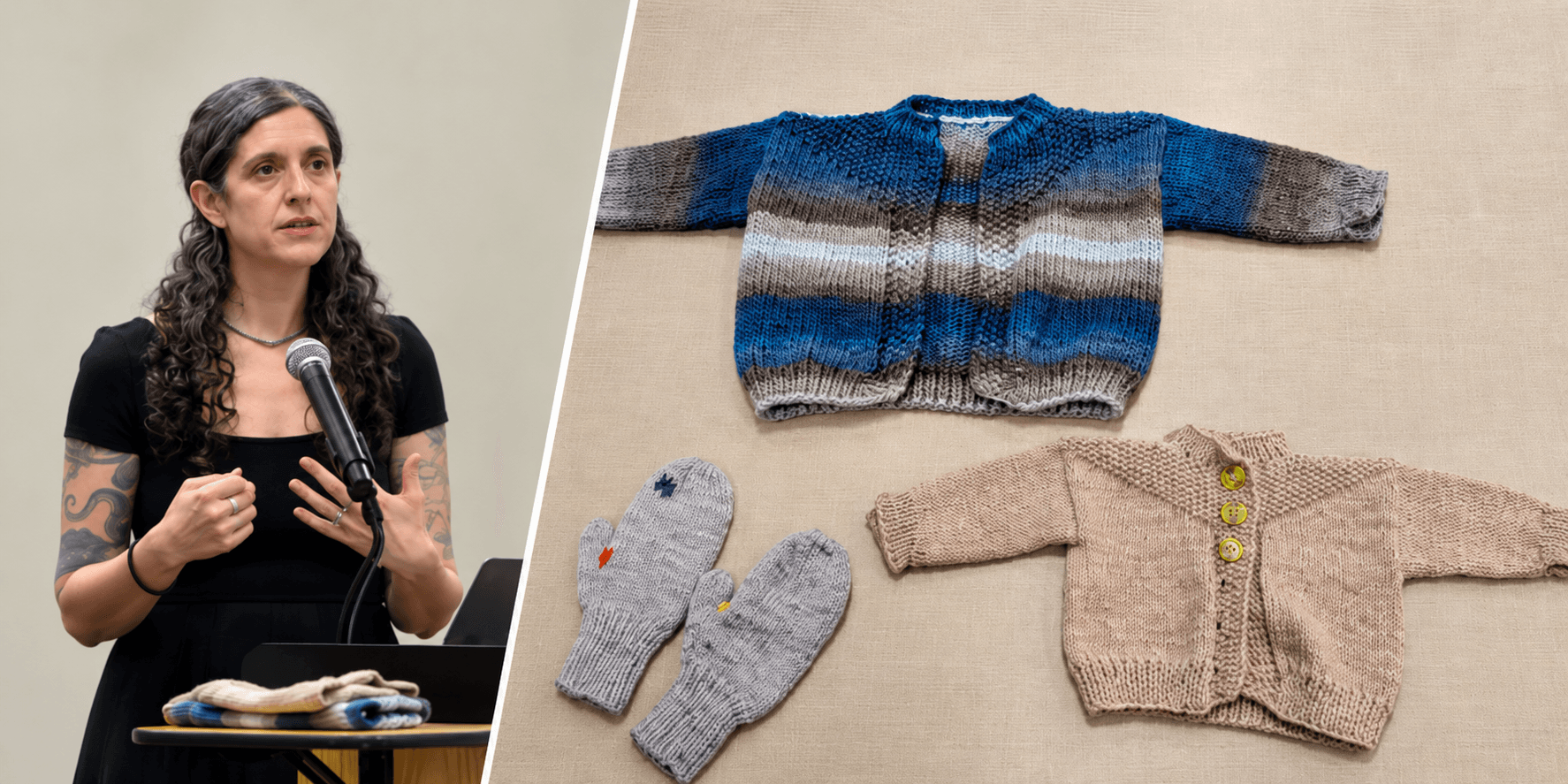
I recently attended Yarns of Resilience: Knitting, Women, and the Holocaust at the Galesburg Public Library. The presentation explored how Jewish women used knitting during the Holocaust to express love, preserve dignity, and create beauty in circumstances that are almost impossible to imagine.
I expected to learn something about history. I didn't expect to be so deeply moved by a tiny baby sweater.
During the presentation, we learned about Lenny Jade, a Jewish woman who was hiding with her husband in the Netherlands during World War II. While in hiding, Lenny discovered she was pregnant. She knew that keeping a newborn with them would endanger everyone sheltering on the farm. To give her baby a chance to survive, she would have to entrust him to strangers.
And still, she knitted for him.
She knitted a tiny sweater with carefully worked decorative patterns. These details weren't necessary to keep her baby warm, but they made the garment something more than ordinary clothing. Even while living in hiding and facing the possibility of never seeing her child again, Lenny took the time to make something beautiful for him.
Just 12 hours after her son Aaron was born, Lenny dressed him in that sweater and gave him to members of the Dutch resistance, who arranged for his protection with another family.
Thankfully, Aaron survived, and he and his parents were reunited after the war. The original sweater was eventually donated to the United States Holocaust Memorial Museum.
The presenter shared how she and her research partner had developed a modern knitting pattern inspired by that sweater. Several knitters who recreated it described powerful emotional experiences. Some felt anger or determination. Others felt hope or a connection to Lenny and her family. Some found themselves unable to give the finished sweater away.
Then the presenter passed around a sweater she had knitted using the pattern.
When it reached me, I held it in my hands.
It was so tiny.
I thought about Lenny, knitting for her baby while knowing she would have to give him away to keep him safe. I imagined the love she must have put into every stitch, making something beautiful for a child she didn't know if she would ever hold again.
I found myself unexpectedly emotional.
Reading about the Holocaust and hearing the stories of those who lived through it are powerful experiences. But holding that tiny sweater made one woman's story feel incredibly personal. It was no longer just something I was hearing about. For a moment, I could feel a connection to a mother whose circumstances were unimaginably different from my own.
The presentation also shared the story of Eva Sternberg, who repeatedly mended her young daughter Miriam's mittens while they were imprisoned at Bergen-Belsen. Even in a concentration camp, with almost nothing available to her, Eva found ways to care for her child and help keep her warm.
These were ordinary acts of love carried out under extraordinary and horrific circumstances.
The Yarns of Resilience project seeks to preserve and share these stories through the knitted objects that survived, helping people connect with history in ways they might not otherwise experience.
I'm grateful that the Galesburg Public Library provided a space for this presentation and that a community supporter helped bring this opportunity to Galesburg.
It's a reminder that some of the most meaningful experiences at our library aren't simply about gaining knowledge. They're about discovering a new perspective, connecting with someone else's story, and carrying that understanding with us long after we've left.
I'll certainly remember that little sweater.

